Costs of the Vehicles of the Future: 2035
The US USDOE analysed a range of technologies in 2013 capable of significantly reducing greenhouse gas emissions and oil consumption, while also taking their cost-effectiveness into account.
This article considers various assumptions and the results of analyses carried out to estimate the full life-cycle costs of several fuel/propulsion technology combinations for a future mid-size car. The results are summarised graphically in the following figure.
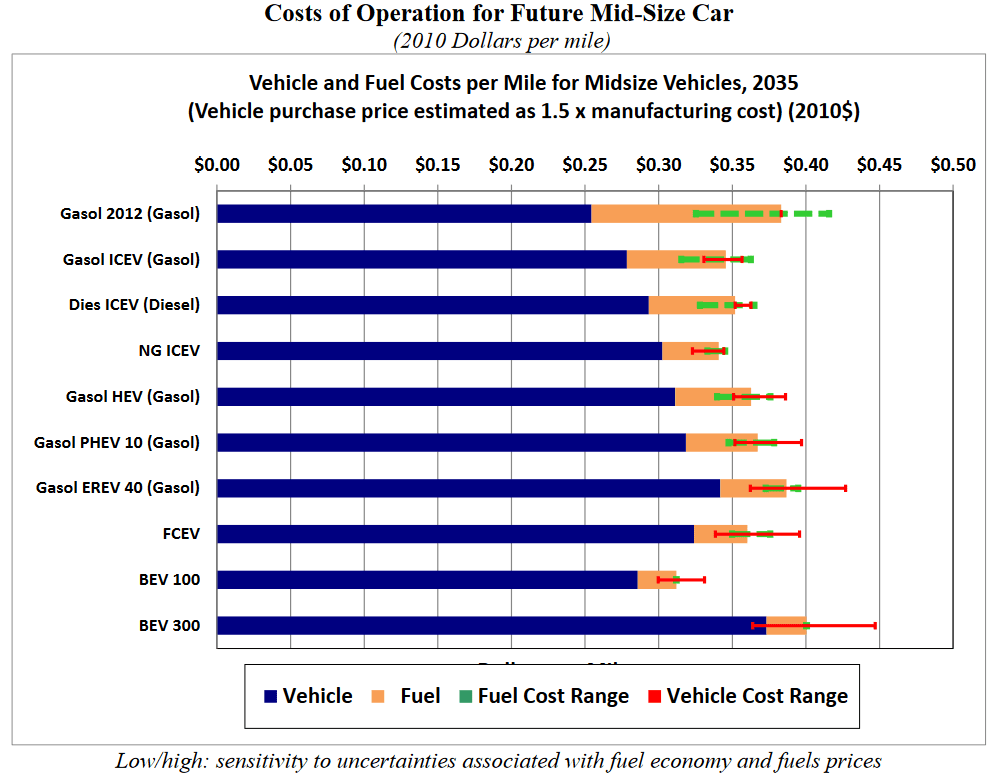
The general conclusion that can be drawn from the table is that, from a strictly economic point of view, the differences between technologies are not particularly large, meaning that a hypothetical buyer’s final decision would be strongly influenced by other factors, such as their specific mobility needs, the level of development of each type of infrastructure in their region, their environmental awareness or the different tax burdens that might apply, for example.
As regards the fuel cell electric vehicle (FCEV), the analysis shows that in just 20 years it could become economically comparable with internal combustion technologies, despite the latter having had many decades of commercial development. Based on the data in the graph, we can estimate a purchase price for an FCEV of around €24,000 (in constant 2010 euros) for a mid-size FCEV with average performance. The cost of purchasing fuel would be around €0.02/km for this vehicle: midway between the most efficient option (around €0.012/km for the BEV 160) and the least efficient, an improved petrol ICE car (around €0.036/km for Gasol 2012). For reference, the fuel cost per kilometre of a current petrol car is around €0.063/km.
About the vehicles compared:
- Gasol ICEV) Petrol vehicle with a spark-ignition internal combustion engine; no hybridisation.
- (Dies ICEV) Diesel vehicle with a compression-ignition internal combustion engine; no hybridisation.
- (NG ICEV) Natural gas vehicle with a spark-ignition internal combustion engine, a modification of the Gasol ICEV.
- (Gasol HEV) Hybrid electric vehicle (HEV), with a spark-ignition petrol engine.
- (PHEV 16) Plug-in (parallel) hybrid electric vehicle, with an electric range of 16km, powered by an electric motor and/or a spark-ignition petrol engine.
- (EREV 64) Extended-range plug-in electric vehicle, with an electric range of 64km, powered by an electric motor and/or a spark-ignition petrol engine.
- (FCEV) Fuel cell electric vehicle.
- (BEV 160) A battery electric vehicle with a nominal range of 160km.
- (BEV 480) A battery electric vehicle with a nominal range of 480km.
The vehicles analysed are based on different improvement scenarios developed by the DOE’s R&D department, including advances in materials, combustion engines, electric motors and generators, batteries, fuel cells and on-board storage systems for natural gas and hydrogen.
The minimum range of each vehicle is approximately 515km, except as indicated for the PHEV 16, EREV 64 and the two BEVs. The PHEV and EREV have a range of approximately 515km using petrol (in addition to their respective electric ranges).
About the data:
- Values for the projected state of the technologies in 2035 (data shown in 2010 euros).
- Costs for high sales volumes (100,000 per year for BEVs and 500,000 per year for FCEVs).
- Payback period: 5 years, 22,500km/year.
- Residual value after 5 years: 25% of the new vehicle price.
- Insurance and maintenance costs are not included. The service life of key components (such as batteries and fuel cells) is assumed to exceed the period considered (5 years), so the impact of maintenance would be relatively small.
- Unit conversion: 1 mile = 1.6km ; €1 = $1.25
- The most recent method developed by the US Environmental Protection Agency was used to calculate on-road fuel consumption.
- Fuel consumption (measured in laboratory conditions according to standard driving cycles) for all fuel/propulsion technology combinations was determined using Argonne National Laboratory’s (USA) “Autonomie” modelling system, a simulation system used to assess the fuel consumption and performance of advanced vehicles.
Conclusions
As the transport technologies mentioned above continue to advance, their cost-effectiveness will become increasingly similar, and the optimal choice will depend on other factors (region, environmental awareness, tax burden, etc.). Once this scenario of economic parity has been reached, it is highly likely that fuel cell electric vehicles will play a prominent role thanks to their environmental advantages and better performance. It is true, however, that by around 2035 they would still be between 10% and 30% more expensive than their petrol equivalents; for Spain and Europe in general, this would represent near economic parity, as this is typically the additional cost associated with diesel vehicles, which are currently predominant in this region.
Among zero-emission vehicles (BEVs and FCEVs), it is interesting to note that fuel cell vehicles could ultimately become cheaper than battery electric vehicles with a similar range: this would mean that the expected reduction in fuel cell costs is greater than that expected for batteries, which are more dependent on the price of the materials from which they are made.
Article based on the report ‘Life-cycle Costs of Mid-size Light-duty Vehicles’, published by the US Department of Energy (DOE) in April 2013.