


Electrolysis and Its Impact on Water Consumption: A Sustainable Approach
Fresh water is an increasingly scarce resource and is essential for life. Many of the processes involved in energy production require large quantities of water, contributing to its depletion and pollution.
This raises an important question: is there a way to store and transport clean, renewable energy without consuming excessive amounts of water? The answer is yes: green hydrogen. Green hydrogen is produced through water electrolysis, a process in which electricity is used to separate hydrogen and oxygen from water molecules. For hydrogen to be considered green, this electricity must come from renewable sources, such as wind or solar power, among others, thereby ensuring that the hydrogen does not contribute to climate change.
Electrolysis requires less water than fossil fuels
Although it is produced from water, green hydrogen consumes far less fresh water than other energy production processes. For example, the petrol refining process requires approximately 7 times more water to produce the same amount of energy as that generated by 1 kilogram of hydrogen [1]. In fact, global hydrogen production accounts for only 0.6% [2] of the energy sector's total fresh water consumption. This highlights the potential of green hydrogen as a renewable energy carrier with very little impact on water consumption.
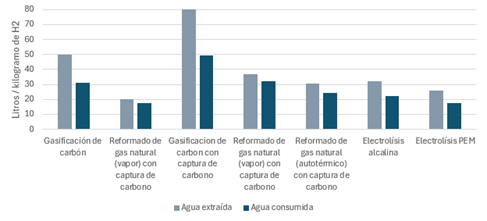
Thanks to its zero CO2 emissions, electrolysis is positioned as the key technology for green hydrogen production and, although it may seem counterintuitive, its moderate water consumption makes it particularly important. According to an IRENA analysis [3], PEM electrolysis requires only 17.5 l/kg of hydrogen, while alkaline electrolysis requires 22.3 l/kg. Both options are considerably more sustainable in terms of water consumption than traditional fossil fuel-based methods, such as methane reforming (32.2 l/kg) and coal gasification (31.0 l/kg), as shown in Figure 1.
Water consumption in electrolysis is not limited to the chemical reaction itself, but also includes cooling to dissipate the heat generated, which is even more significant. The IRENA study reveals that, generally across all types of water, only 44% of the water required by the system is used directly for the electrolysis process, while the remaining 56% [4] is used for cooling.
Optimising the process is key
Therefore, optimising these systems is crucial to reducing water consumption and increasing the overall efficiency of the process. To understand the scale involved, imagine a reservoir with a volume of 500 hm³, such as the Ebro Reservoir [5]. Producing 1 million tonnes of green hydrogen would require only 3.2% of its capacity, which is similar to the annual consumption of a city such as Alicante (assuming an average consumption of 133 litres per inhabitant per day [6]). Although this may seem considerable, it is less than the amount used by sectors such as agriculture or industry, and that hydrogen could supply electricity to almost one third of Spain's population for a year. And what happens to the water used? It is not all lost.
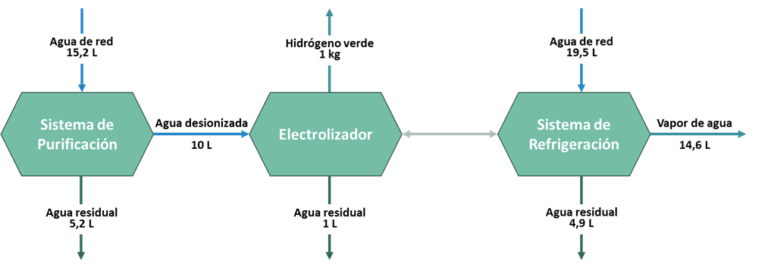
In the specific case of mains water, which is the purest, around 30% becomes wastewater (brine) and can be treated and returned to the environment. Approximately 30% is consumed during electrolysis and around 40% is returned to the environment as water vapour, responsibly closing the cycle (as shown in the production plant diagram, Figure 2).
Furthermore, the geographical location of facilities is a determining factor in the environmental impact of the process. For plants that use seawater and are located near large bodies of salt water, the resulting brine can be discharged directly into the sea. Inland plants, however, require alternative disposal methods due to the absence of nearby saline bodies. Local regulations, established by the River Basin Authorities in each region, determine how and where wastewater can be discharged, ensuring that the impact on the environment is always managed responsibly.
Solution: desalinating seawater?
Water scarcity represents a significant challenge to global sustainability, with a particular impact on the energy industry. But how does this situation affect green hydrogen production? To address this challenge, existing techniques such as desalination, rainwater harvesting and greywater treatment have been utilised. These alternative methods of producing fresh water make hydrogen production viable worldwide, even in water-scarce regions.
Currently, more than 35% [3] of global green and blue hydrogen production capacity is located in water-scarce regions. Therefore, using seawater for hydrogen production and cooling is an effective strategy for reducing fresh water demand and mitigating the risks associated with water scarcity. Although desalination may marginally increase production costs, it is a sustainable solution for hydrogen production, reducing pressure on water resources and supporting a more sustainable and environmentally responsible energy future.
Desalination begins with the intake of seawater. During this initial process, filters are used to protect marine life and ensure water quality. Once collected, the water undergoes a pre-treatment stage to remove suspended particles and organic matter that could damage the desalination membranes.
At the heart of the desalination process is the separation of fresh water from dissolved salts. Two main methods are used for this purpose: thermal distillation and reverse osmosis. Thermal distillation involves heating salt water to produce steam, which is then condensed. Reverse osmosis, which is more energy-efficient, forces salt water through a semi-permeable membrane under pressure, producing fresh water and leaving behind concentrated brine.
Moderate increase in cost
Internationally, the seawater desalination process would add only between 0.5% and 1% to the cost of one kilogram of green hydrogen, according to a report by Caldera and Breyer [7]. At present, this increase is not excessive, as countries such as Spain have an LCOH (an indicator of the cost of producing a given quantity of hydrogen, taking into account all the costs involved in its production) of around €5 or €6/kg [8].
The case of Chile
As an example, a pilot plant committed to green hydrogen stands out in Chile's arid Atacama Desert. With a capacity of 10 MW, this facility aims to produce 350 tonnes of green hydrogen per year [9][10][11]. How will it achieve this in a location with so little water? The answer lies in desalination. Assuming that this plant desalinated 100% of the water it uses and taking an average cost of 3.0 kWhel/m3 [7], this would result in only a 0.1% increase in installed capacity, demonstrating the minimal increase in cost that this would entail.
With responsible consumption and innovative technologies such as desalination, green hydrogen is emerging as a viable solution for a sustainable energy future. Unlike traditional fossil fuel-based methods, green hydrogen consumes less water and does not emit polluting gases, helping to preserve our planet for future generations. Research and the development of new technologies, such as direct seawater electrolysis, point towards an even more efficient and sustainable future for green hydrogen production. It is time to embrace this energy alternative and turn hope into reality, creating a future in which clean energy and water coexist in harmony.
References
1. Castellanos, E. (2017, 13 January). The water used to manufacture things. iAgua.
3. Water for hydrogen production. (2023, 1 December).
4. Comparison of Commercial, State-of-the-Art, Fossil-Based Hydrogen Production Technologies. Lewis, E. J., et al. (2022).
5. Updated data for the Ebro Reservoir. (n. d.-b). Embalses.net.
6. INE – Spanish National Statistics Institute. Statistics on water supply and sanitation. INE.
7. Caldera, U., & Breyer, C.(2017). Learning Curve for Seawater Reverse Osmosis Desalination Plants: Capital Cost Trend of the Past, Present, and Future. Water Resources Research, 53(12), 10523-10538.
- Levelised Cost of Hydrogen Calculator | European Hydrogen Observatory. (n. d.).
- Haru Oni: Green Hydrogen Made in Chile.(n. d.).
- Castro, M. (2023, 31 January). Green hydrogen attracts investors in Chile. Bloomberg Línea.
- De Mendoza – Memo, N. (2022, 25 January). Chile to turn seawater into drinking water at a rate of 21,000 litres per second. Memo.