Hydrogen Uses and Applications
The use of hydrogen (H) is essential for numerous industrial processes, and it also has applications in the energy sector and transport.
This gas is the lightest and most abundant element in the universe. Despite this, it is rarely found on Earth in its elemental form and, under normal conditions, is produced artificially. The most common form in which this gas is produced is as a diatomic molecule (H2).
According to the Fuel Cells and Hydrogen Observatory (FCHO), in 2020 almost 31 tonnes per day of hydrogen were produced in Europe, while around 8.6 million tonnes were consumed in total, with four countries (Germany, the Netherlands, Poland and Spain) accounting for the consumption of more than half of the gas produced on the continent.
According to data from the European Commission, hydrogen accounts for less than 2% of the continent's total energy consumption and is mainly used in the manufacture of chemicals, plastics and fertilisers.
Currently, 96% of hydrogen production in Europe is through methane reforming (the main component – > 90% – of natural gas), which results in the emission of significant quantities of CO2 into the atmosphere.
Petroleum refining and the chemical industry
The petroleum refining sector is the largest producer and consumer of hydrogen in Europe, as this gas is essential for converting crude oil into products such as petrol, diesel, kerosene, naphtha and asphalt through various processes (“hydrocracking”, “hydrotreating”…).
The ammonia industry — a chemical compound used mainly in fertilisers for agriculture — is the second-largest producer and consumer of hydrogen in the European Union.
The chemical industry also requires large quantities of this element to produce compounds such as hydrochloric acid, hydrogen peroxide and aniline (used to manufacture polyurethane, synthetic paints, antioxidants, varnishes and explosives, among other products). 100 cm sex dolls
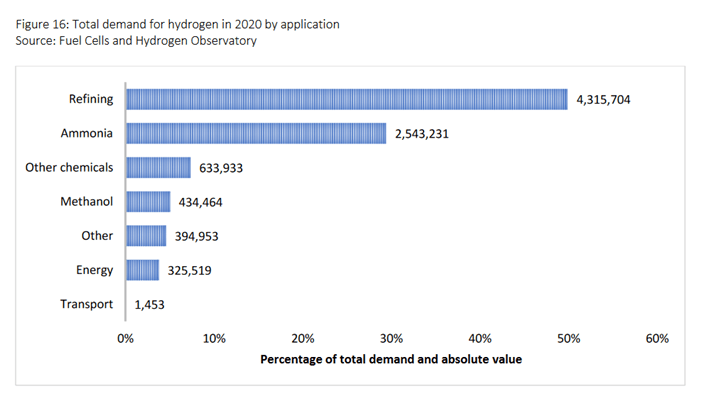
Total demand in 2020 by hydrogen use and application. / FCHO
Other industries
Hydrogen is used together with nitrogen in the metallurgical industry to create a protective and inert atmosphere in metal annealing furnaces. In the glass industry, it is used to produce flat glass (used for windows, glass doors, windscreens, etc.) and in glass polishing processes.
In the food industry it is used to hydrogenate oils and convert them into fats (hydrogenated fats).
Hydrogen as an energy carrier
In 2020, energy production and consumption was the sector responsible for the largest share of greenhouse gas emissions in Europe, at 30%, due to its heavy dependence on fossil fuels.
To decarbonise this sector, the European Commission has launched ambitious funding plans, such as REPowerEU and Fit for 55, in which hydrogen plays a key role as an alternative form of energy.
Unlike gas or oil, hydrogen is not a fuel, but an energy carrier: a means of storing and transporting energy.
Hydrogen can be stored in large quantities and for long periods of time for use as a large-scale energy source, a characteristic that is particularly relevant when it comes to balancing electricity consumption and renewable energy production, where electrolysis systems could facilitate the development and improved management of electricity grids.
One of the main challenges of relying on energy generated from renewable sources is its unpredictability: a period of high electricity demand may coincide with a day when there is no wind or when it is cloudy, and vice versa.
Hydrogen storage systems with electrolysers would solve this problem, because “if we have electrolysers in the electricity system, we can activate them when there is surplus wind or solar power, thereby preventing that energy from being wasted or wind farms from having to shut down, which leads to economic losses for everyone”, explains Pablo Lara, Project Manager at Ariema and lecturer on the hydrogen course. “The gas can then be used to generate electricity again, or not”.
Hydrogen storage systems could also complement or replace the generator sets currently used to generate energy from gas or diesel.
Among their benefits, they improve the energy density of battery systems, meaning that they take up less space than battery systems for the same amount of energy, “and if they are high-temperature fuel cells, they can also be used to produce domestic hot water at the same time”, Lara explains.
Hydrogen in fuel cells (Fuel Cells)
Fuel cells are electrochemical devices that convert a fuel, in this case hydrogen, into electrical energy with minimal environmental impact and very high efficiency, since, unlike thermal devices, their performance is not dependent on the limit imposed by the Carnot Cycle.
There are several types of fuel cells, depending on the characteristics of the electrolyte and catalyst they use, their size and their operating temperature.
Fuel cells that generate electricity at high temperatures are more suitable for stationary applications, as they are heavy and have significant thermal inertia, but they offer higher efficiencies and a longer service life.
On the other hand, there are smaller fuel cells with rapid start-up times: this type is designed for sectors such as transport, where low weight and compactness are more highly valued. One example is the fuel cell that uses a Proton Exchange Membrane (PEM) electrolyte.
Hydrogen in transport
Hydrogen can be used as a form of fuel in transport. This is particularly relevant considering that this sector was responsible for 27.1% of greenhouse gas emissions generated in Europe in 2020.
H2-powered electric vehicles, known as hydrogen fuel cell electric vehicles (FCEVs), use a fuel cell to convert hydrogen, as an energy carrier, into electricity, which is then used to power an electric motor.
This enables vehicles to operate without emitting carbon dioxide (CO2) or other pollutants, producing only water vapour. Another advantage is that they offer a driving range similar to internal combustion engine vehicles and can be refuelled quickly. However, there are challenges with the current hydrogen infrastructure, as it is still relatively underdeveloped and there are few refuelling stations available.
In heavy transport, hydrogen can be used as a fuel in lorries and trains. This energy carrier has been used in trains since the early 20th century in countries such as Germany, but its use has been limited due to costs and the lack of hydrogen infrastructure. However, investment is currently being made in the development of hydrogen-powered systems for heavy-duty vehicles, as they can provide a cleaner alternative to fossil fuels.
At present, hydrogen combustion engines are also being tested for aviation, road and marine transport; other sectors with a significant carbon footprint.
Overall, the use of hydrogen in the transport sector is one of the alternatives for reducing greenhouse gas emissions and contributing to the fight against climate change. However, challenges remain before it can be deployed on a large scale, mainly the lack of infrastructure and high production costs.
The future lies in hydrogen
Hydrogen generated using renewable electricity — green hydrogen — is a highly promising alternative for decarbonising sectors such as the steel and fertiliser industries, as well as electricity generation and transport. Combined, these sectors generate more than half of the European Union's greenhouse gas emissions.
The important role of hydrogen has been recognised by the European Commission, which has developed a hydrogen strategy, giving it a central role in the continent's net-zero future.
Spain has also recognised the importance of hydrogen through strategic documents such as the Hydrogen Roadmap, which identifies the challenges and opportunities associated with this energy carrier, with the clear objective of positioning the country as a leader in both technology and exports.