The Hydrogen Value Chain
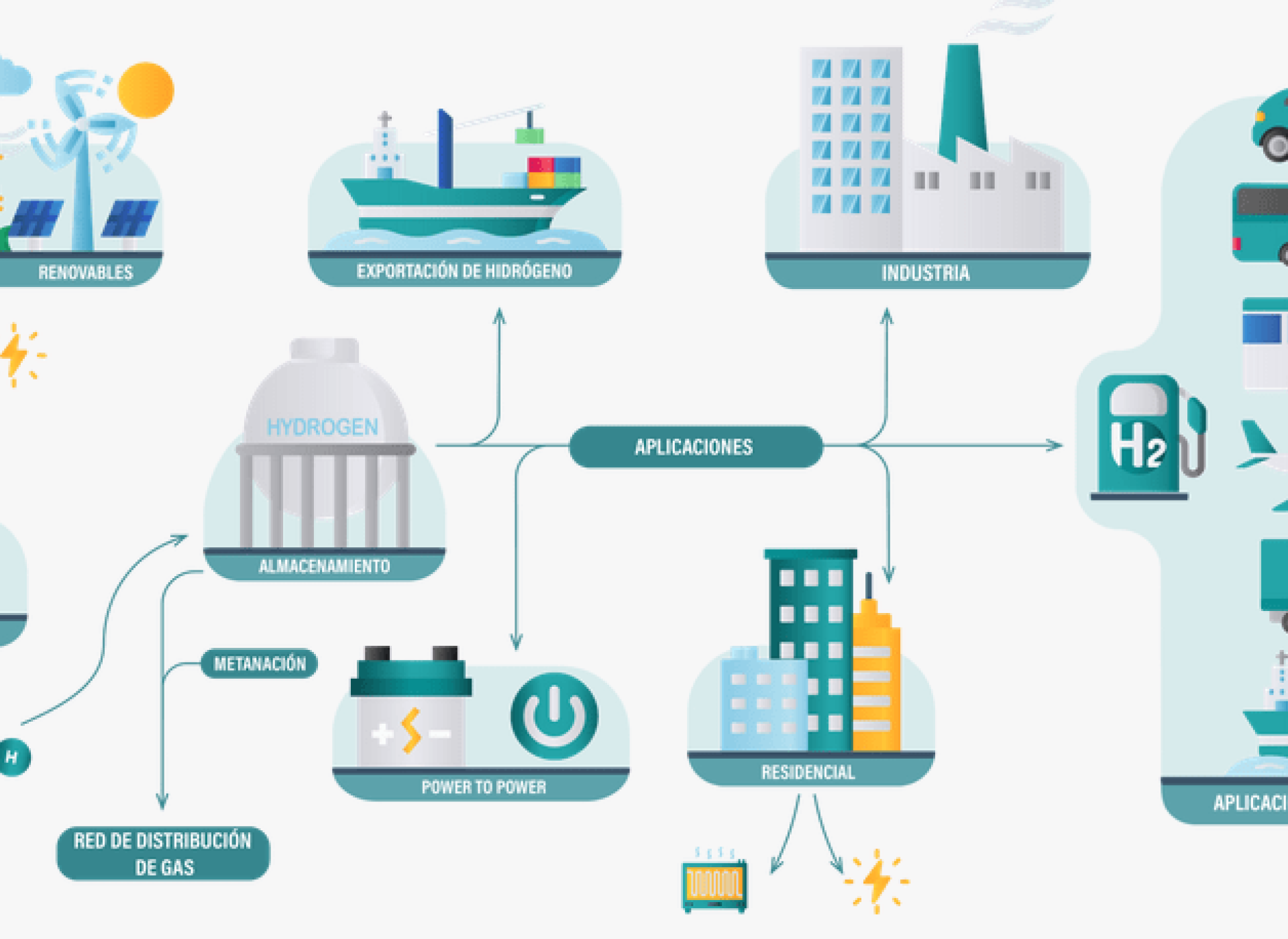
The so-called hydrogen value chain refers to the three stages that this element passes through during its industrial life cycle: production, distribution and/or storage, and application or end use.
Within the industrial sector, hydrogen has played an important role for many years. However, in 2020 it began to experience unprecedented growth that has since attracted the interest not only of the sector itself, but also of government institutions and the media. Evidence of this can be seen in the European Commission's establishment of a ‘Hydrogen Roadmap’ within the EU strategy for energy system integration, which highlights the importance of green hydrogen in achieving climate neutrality by 2050.
Hydrogen obtained through ‘green’ methods is emerging as a non-polluting alternative in its own right, as it is an energy carrier that can be used to generate heat and electricity. This makes it possible to decarbonise key sectors of the economy that would otherwise be difficult to decarbonise from an economic perspective.
European governments are focusing their efforts on implementing a value chain that significantly limits the emission of polluting gases into the atmosphere. In this regard, most R&D&I investment is focused on the production stage.
Hydrogen production
The first link in the hydrogen value chain is its production, as hydrogen is very rarely found in its elemental form on Earth. It exists in a stable form as a diatomic molecule (H2), although it is more commonly found combined with other chemical elements, such as carbon (hydrocarbons).
Historically, hydrogen gas has been extracted from fossil fuels through chemical processes such as steam reforming, releasing large quantities of greenhouse gases in the process. According to data from the European Commission, 96% of the hydrogen currently produced in the European Union comes from natural gas.
Other, less developed production methods include chemical reduction (reduction-oxidation), thermolysis, biological production and electrolysis.
This latter option, which obtains hydrogen from water by applying electricity under certain conditions, does not directly generate emissions and is therefore an interesting production alternative for the energy transition. It produces high-purity hydrogen, but remains marginal — in 2020, it accounted for just 0.14% of total hydrogen production capacity in Europe—.
However, projects using this technology are growing exponentially, and by 2021 hydrogen production using this technique was expected to reach 60 tonnes per day, an increase of 97% compared with 2018, according to data from the Fuel Cell Hydrogen Observatory (FCHO).
Where does the electricity used for electrolysis come from?
Although producing hydrogen through electrolysis does not itself generate greenhouse gases, the source of the electricity used to produce the molecule must be taken into account before it can be labelled ‘zero emissions’.
Therefore, so-called ‘green hydrogen’ is only obtained when the electricity used also comes from a renewable source, such as wind or solar power. However, this production method is still more expensive than generating hydrogen from fossil fuels.
After production, the next links in the hydrogen value chain are its storage and distribution.
Hydrogen storage
Hydrogen is the lightest element in the periodic table and, because of its low density, it is costly and difficult to store, as it needs to be contained at very high pressure.
There are several forms of storage, depending on its physical state (gas, liquid or solid).
- Hydrogen gas
The most common way of storing hydrogen gas is in steel tanks, although tanks made from composite materials are becoming increasingly common, as they are lighter and designed to withstand higher pressures.
One way of increasing the density of the gas and storing a greater quantity in the tank is to cool it to near-cryogenic temperatures, producing what is known as cryo-compressed hydrogen.
Another way of containing hydrogen gas is through glass microspheres: hollow glass spheres are first filled with hydrogen at high pressure and temperature and, when they cool, the gas becomes trapped inside them.
To release it, the microspheres are heated again. One of the disadvantages of this storage method is the low volumetric density that can be achieved.
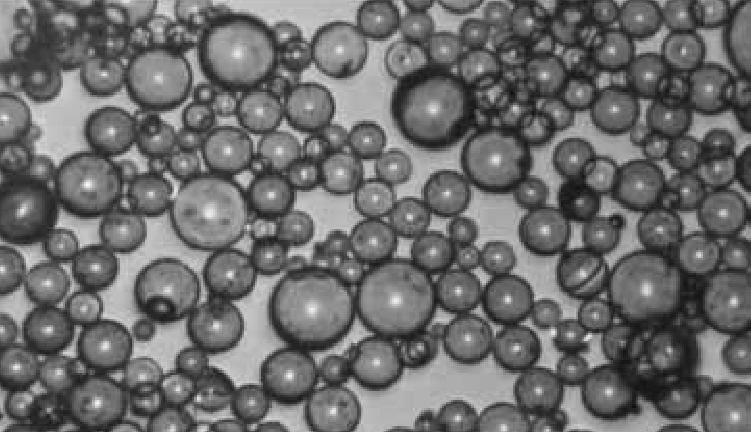
Glass microspheres viewed through a microscope. (IEA,Teitel).
- Liquid hydrogen
Hydrogen can be cooled to cryogenic temperatures (-253ºC), with the main advantage being that its energy density per unit of volume is much higher than that of gas-based solutions, even at low pressures.
It is stored in structures known as Dewar vessels (a common application of a Dewar vessel is a vacuum flask).
Its disadvantages include the high cost of liquefaction and the fact that between 30 and 40% of the energy is lost during the process. Even so, its commercial viability has been demonstrated for vehicle propulsion (BMW), and in the future it could serve as a fuel for aviation, as this form of storage offers the greatest advantage in terms of mass per unit of volume.
Another form of liquid storage involves using borohydride solutions, where hydrogen is released through a catalytic hydrolysis reaction, or organic liquids such as toluene (C7H8) or methylcyclohexane (C7H14).
- Solid hydrogen
Storing hydrogen in solid materials has the potential to become a safe and efficient way of storing energy for both stationary and mobile applications, although this technology is still at a very early stage of development.
There are four groups of potentially suitable materials: carbon; H2O-reactive chemical hydrides; thermal chemical hydrides; and rechargeable hydrides.
Hydrogen distribution and transport
Hydrogen is frequently produced for consumption in situ, as is the case in refineries or the metallurgical industry.
When hydrogen is generated some distance away from the area where it will ultimately be used, transport logistics come into play.
Hydrogen gas is normally transported through infrastructure based on pipeline networks, like any other gas (hydrogen pipelines), while in liquid form it is transported by tanker lorries —with an average load capacity of between 400 and 4,000 kg—, or by hydrogen tube trailers.
Recently (2020), a pilot test was carried out to transport non-refrigerated liquid hydrogen by sea between Japan and Australia, using the Japanese vessel ‘Suiso Frontier’.
Application or end use
The final link in the hydrogen value chain is its application or end use. Hydrogen has numerous applications at all levels, ranging from large-scale uses (refineries and chemical plants) to smaller-scale applications, such as fuel cells or scientific research in laboratories.
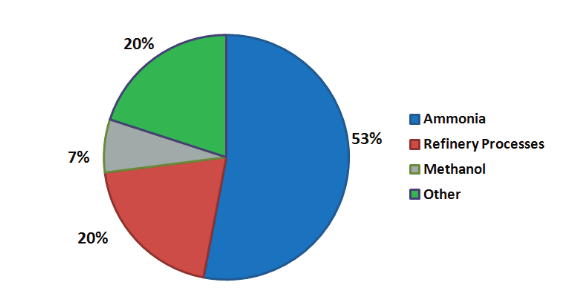
Uses of Hydrogen. P.Ruiz, L. Vega, M. Arxer C., Jimenez, A. Rausa
In an industrial context, it is used to produce ammonia, an essential ingredient in fertilisers; to generate methanol, which is used in the manufacture of various types of polymers; and to refine oil and obtain by-products, among many other applications.
It can also be used as an energy carrier in fuel cells and as a replacement for petrol and diesel in vehicles.
To learn more about the applications of hydrogen, click on this link.