


PMH2: Discussion Session on Private Investment Strategies for Hydrogen Projects
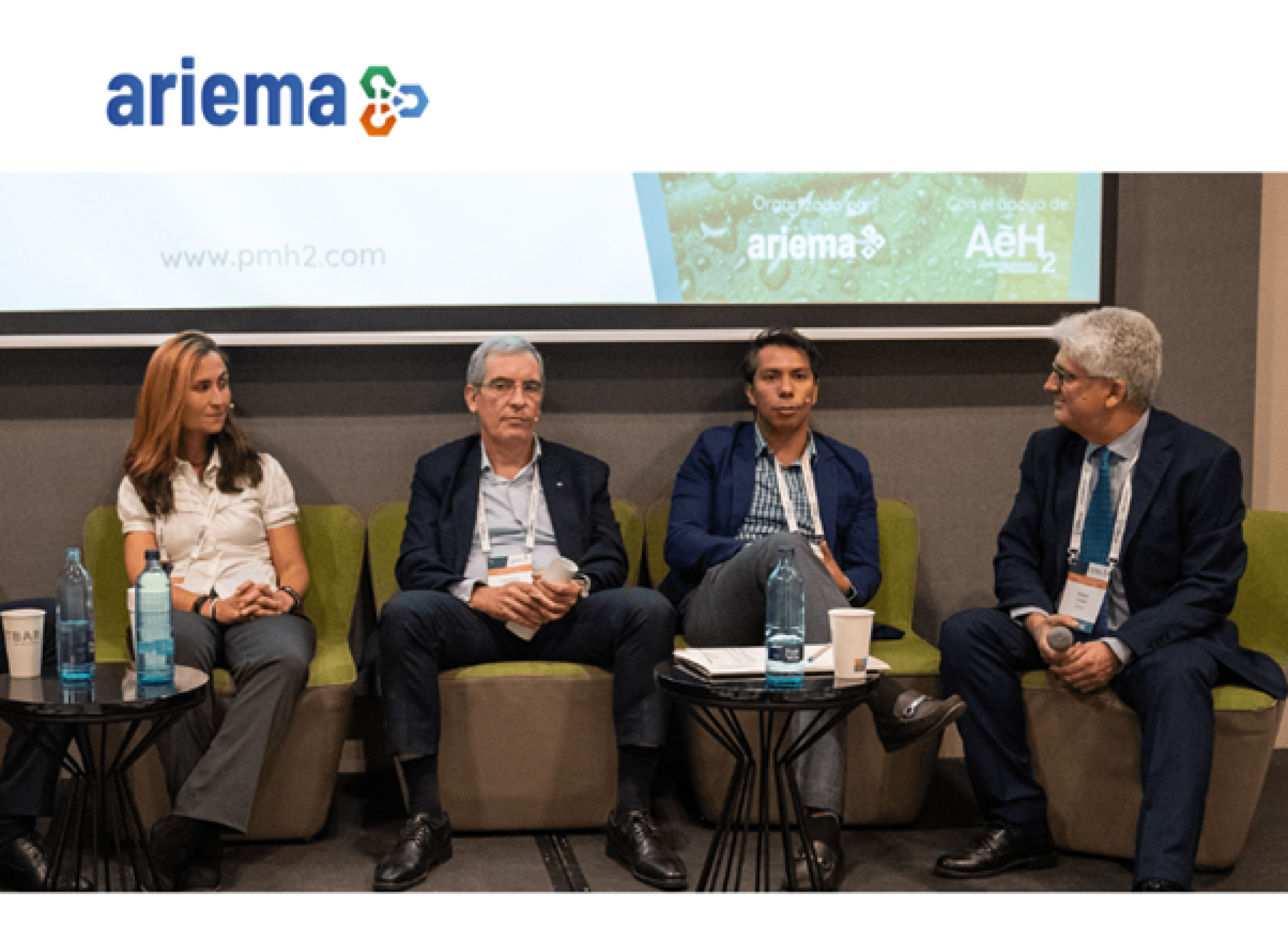
Madrid, October 2023 -. One of the main highlights of the event was the financing sessions. In this case, experts from the private financial sector representing Axon Partners Group, with Axon partner Luis Castañeda; Urbano Troncoso, Hydrogen Project Finance at Banco Santander; Matrix Renewables, represented by Beatriz Ruiz, Head of Energy Storage and Renewable Hydrogen; and the Managing Director for Spain of Smartenergy, Jose María Llopis, gathered for a round-table discussion to share ideas and exchange views on different strategies for financing hydrogen-related companies and projects.
ARIEMA's CEO, Rafael Luque, acting as moderator of the round table, introduced the discussion, which provided guidance on the requirements that companies seeking financing should take into account.
During this session, the critical elements underpinning the financing of green hydrogen production projects were addressed. The factors influencing their viability were also assessed, and the key aspects discussed throughout the meeting were summarised.
Financing a green hydrogen company or facility
The participants stated that considering the viability and feasibility of projects, as well as having control over energy production and supply due to their impact on project costs and viability, are essential requirements when considering whether to finance a project.
As far as Axon Partners Group is concerned, its main interest lies in financing projects at different stages of development, from the earliest stages through to more mature projects.
Axon focuses on financing the investment required to reach a Minimum Viable Product, production plant or proof of concept that can be brought to market. - stated the Axon representative.
Smartenergy, meanwhile, considers factors such as commercial feasibility, the existence of “off-takers” or consumer entities entering into long-term energy purchase agreements for hydrogen or its derivatives, as well as the potential demand for hydrogen. The investor also seeks a hydrogen production strategy that aligns with its production plants and 40-50 MW electrolysis projects.
“More than 60% of the cost of hydrogen is the cost of the energy used to power the electrolyser, and therefore it is essential to have long-term certainty and, within the project structure, control over the company that owns the renewable energy assets” - stated Smartenergy's Managing Director for Spain.
Banco Santander's Head of Hydrogen Project Finance, meanwhile, highlighted that the bank maintains discussions with various companies and considers several aspects when evaluating potential projects. These include the nature of the project, the company's financial strength, its level of flexibility and the introduction of innovative financial instruments for disruptive technologies. As regards projects, Banco Santander focuses on those that are economically viable, backed by recognised buyers in the market and supported by government initiatives, although it remains open to evaluating proposals of different kinds.
Finally, Beatriz Ruiz, Head of Energy Storage and Renewable Hydrogen at Matrix Renewables, stated that Matrix is committed to developing “greenfield” projects, meaning projects that are not subject to constraints imposed by previous work, while also considering investments in more mature projects and established portfolios. The company is also assessing the possibility of supporting pilot hydrogen storage projects connected to the electricity grid in order to incorporate proven technologies into its commercial projects.
Risk factors influencing the likelihood of success
The Axon partner highlighted the importance of addressing and distributing project risk fairly, as well as having a skilled and complementary team capable of implementing and commercialising the project and translating technical language into understandable commercial terms.
Smartenergy, meanwhile, stated that one of the main obstacles is the lack of definition within the environmental regulatory framework, compounded by the ambiguous interpretation applied by the competent authorities in each autonomous community. The expert also stated that another fundamental challenge lies in overcoming the gap between the price consumers are willing to pay for hydrogen and the cost of producing it.
Consequently, another key challenge concerns the “gap” between the price consumers are willing to pay for hydrogen and the price at which producers are willing to produce it, referred to as the “financing gap”. Nevertheless, the Managing Director stated that the launch of the European auction currently provides an instrument that acts as a “bridge” to address this “financing gap”, given the possibility of enabling long-term contracts, for example over 10 years, through mechanisms such as the European Hydrogen Bank.
As far as Matrix is concerned, its hydrogen representative stated that it is important to take traceability criteria into account and to have certifications for materials and products as a key aspect of investment. She also noted that there is some uncertainty surrounding subsidies and the assumptions underpinning investments, meaning that these need to be realistic in order to attract financing.
In summary, the participants highlighted the importance of selecting the right strategic partners, addressing and distributing project risk fairly, finding investors who can add value from an industrial perspective, and applying lessons learned from other sectors to the development of green hydrogen projects.
A recording of the round-table discussion is available in the private area of the PMH2 website.