


What Is White, Gold or Natural Hydrogen?
Within the framework of the energy transition, the search for sustainable energy sources has become increasingly important. In this context, hydrogen stands out as a key energy carrier due to its ability to store energy that can be used in a process free from carbon dioxide emissions. In recent years, considerable progress has been made in the different routes for producing and obtaining hydrogen, giving rise to a colour-based classification, as shown in Figure 1.
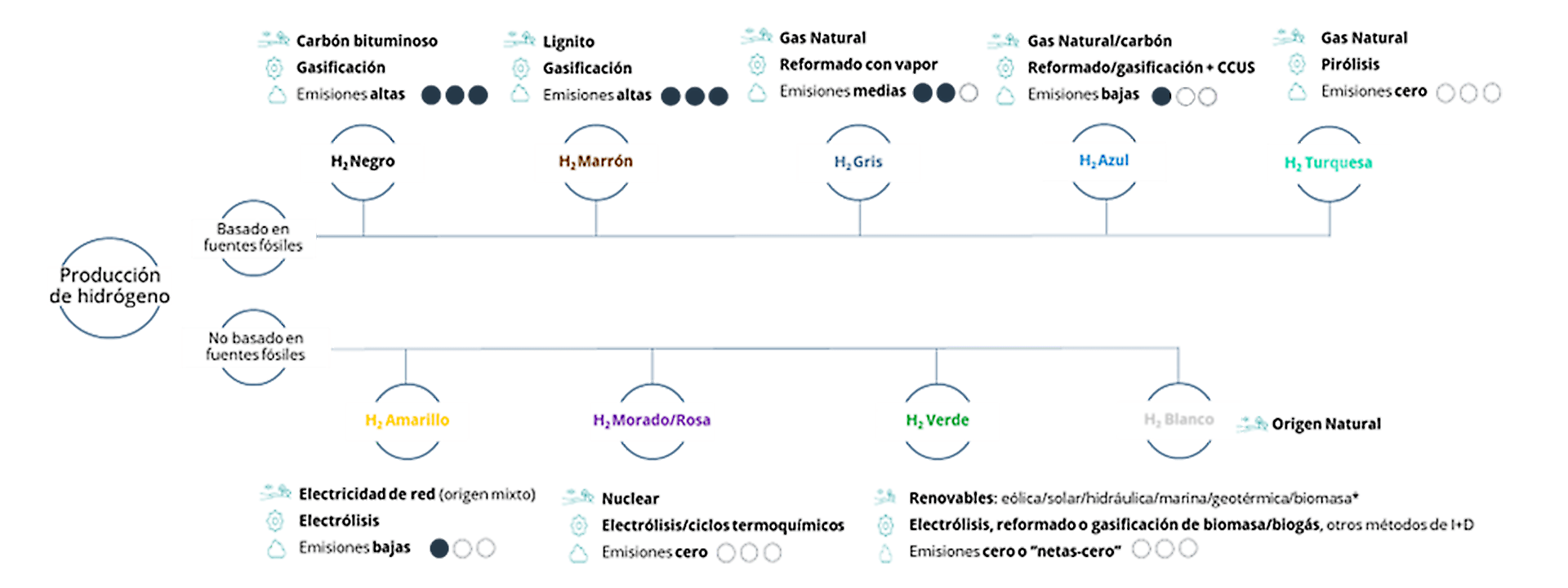
Figure 1. Hydrogen colours according to their origin and emissions. Based on the International Energy Agency (IEA) presentation “Hydrogen Production” [1]
What is white, gold or natural hydrogen?
White hydrogen, also known as gold or natural hydrogen, is hydrogen that occurs naturally in the Earth's crust, without the need for human intervention in its production [2]. Unlike grey, blue or green hydrogen, which is produced through reforming processes involving other compounds or water electrolysis, white hydrogen is generated as a result of a series of natural geological processes.
The natural sources of white hydrogen are diverse, and their discovery is a relatively recent area of scientific research. Hydrogen underground reserves have been identified in different parts of the world, both on land and beneath the seabed. These reserves are linked to the circulation of hydrothermal fluids through ultramafic rocks, a process observed in various geological environments [2]. Other geological processes capable of generating hydrogen naturally include: radiolysis of water due to the decay of radioactive elements such as uranium, thorium and potassium; serpentinisation, in which, at high temperatures, water reacts with iron-rich rocks to produce hydrogen through the oxidation of Fe2+ and Fe3+ and the reduction of H2O; pyritisation, where H2S from the degradation of organic matter in the absence of O2 reacts with FeS, releasing H2 and forming FeS2; anaerobic fermentation by bacteria and cyanobacteria; thermal decomposition of methane into graphite and H2; stimulated production by injecting CO2 and/or water vapour into the subsurface containing rocks of a particular composition (Mg, Ca and Fe oxides); or the direct emission of H2 from the Earth's core and mantle.
Figure 2, taken from the article “Hidden Hydrogen” (Science) [3], illustrates the various mechanisms of generation, loss and extraction of white hydrogen in the Earth's crust, listed as “(X)”. The generation processes include the most significant of those already mentioned: radiolysis (1), serpentinisation (2), and hydrogen flows from the Earth's core or mantle (3), which rise along tectonic plate boundaries and faults.
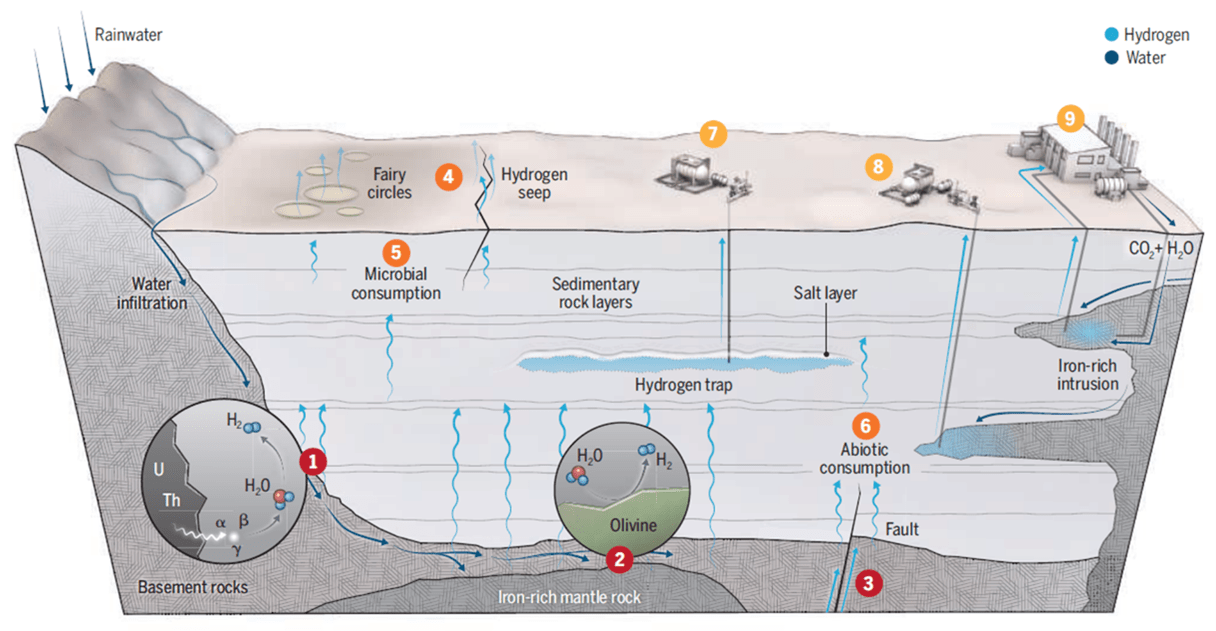
Figure 2. Mechanisms of generation, loss and extraction of white hydrogen in the Earth's crust. / Eric Hand. [3]
The mechanisms responsible for the loss of white hydrogen shown in the figure include rapid migration through faults and fractures [4], as well as diffusion through rocks.
These leaks, which are generally weak, could explain surface depressions sometimes known as “fairy circles”, circular patterns of bare ground surrounded by rings, usually of vegetation. Figure 3 shows an illustration of these phenomena in the Namib Desert, the best-known example. In shallower layers of soil and rock, microbes consume hydrogen for energy [5], often producing methane. At deeper levels, hydrogen reacts with rocks and gases to form water, methane and mineral compounds [6].

Figure 3. Fairy circles in the Namib Desert. / Danita Delimont Creative / Alamy Stock.
White hydrogen extraction methods
As regards extraction methods, hydrogen could be extracted in a similar way to oil or natural gas, by drilling into reserves trapped in porous rocks beneath salt deposits or other impermeable rock layers [7]. It may also be possible to exploit iron-rich rocks directly if they are sufficiently shallow and fractured to allow hydrogen to be collected [8]. Another possibility involves injecting water into these iron-rich rocks [9], thereby stimulating hydrogen generation while also capturing CO2 from the atmosphere as an additional benefit.
Globally, interest in this energy source has grown considerably, driven by its potential to provide a sustainable and carbon-free alternative. Various projects and studies are under way, exploring both the feasibility of extraction and the utilisation of white hydrogen. Figure 4 shows the global distribution of potential continental ultramafic rocks, sedimentary serpentinite and continental basalts. Four key locations in project development are highlighted in the figure: New Caledonia, Mali, north-west Borneo and the south-west Gulf of Mexico.
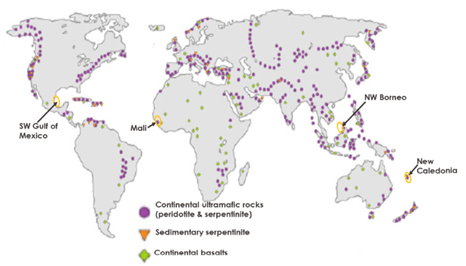
Figure 4. Global distribution of potential continental ultramafic rocks, sedimentary serpentinite and continental basalts. / M. A. Meju and A. S. Saleh.
Notable white hydrogen extraction projects
Among the most notable projects are explorations in regions such as Lorraine, France, where a white hydrogen deposit has been discovered beneath a former coal mine. This deposit is estimated to contain around 46 million tonnes of this type of hydrogen, which would be equivalent to four times Europe's hydrogen production target from electrolysis for 2030. This makes the deposit one of the largest known reserves to date [5]. In Mali, near the village of Bourakebougou, a natural hydrogen deposit has been exploited for more than a decade, producing gas composed of 98% hydrogen that is used to generate local electricity without emissions [3].
Another relevant example is the study of white hydrogen deposits in the Mid-Atlantic region of the United States, specifically in the coastal plain of North Carolina [2]. Although the sources and potential of these deposits are still being investigated, their discovery challenges previous assumptions about the production and distribution of white hydrogen.
Another interesting case worthy of study is that of the “eternal flames of Turkey” at Yanartaş, known as the ancient Mount Chimaera. This site, near the Olympos Valley and Beydağları Coastal National Park, is characterised by permanent flames caused by emissions of methane (87%) and hydrogen (7.5-11%), among other gases. Although these flames historically served as a landmark for sailors, today they attract hikers and walkers [6].
In Spain, the Monzón project, in the province of Huesca, is of great importance and places the country in a prominent position in the field of white hydrogen exploration. Helios Aragón, a start-up founded by two geologists, aims to extract hydrogen in Monzón and the surrounding area. The first appraisal well will be drilled in 2024, and the deposit is expected to be capable of producing up to 1.1 million tonnes of hydrogen per year for 20-30 years, generating a significant economic impact and numerous jobs [7]. This project stands out not only for its economic potential, but also for the lessons learned in terms of cooperation between the public and private sectors and the importance of adapting legislation to facilitate white hydrogen extraction. If the project in Huesca is successful, Spain could become a world leader in natural hydrogen production, consolidating its position at the forefront of sustainable energy technologies.
Potential of white hydrogen in the energy industry
As mentioned above, white hydrogen has considerable potential as an emission-free energy source. Unlike grey and blue hydrogen, which involve CO₂ emissions (with or without carbon capture), white hydrogen is completely emission-free from its origin through to its end use [8]. This characteristic makes it an interesting option in terms of environmental impact.
Compared with other sources of hydrogen, white hydrogen stands out for its efficiency and lower production-related costs. While green hydrogen requires renewable energy for water electrolysis, white hydrogen is already present in the Earth's crust and only needs to be extracted, which may result in lower operating costs [2]. Furthermore, its exploitation does not involve water consumption, an increasingly valuable resource. Hydroma currently extracts white hydrogen in Canada at an estimated cost of $0.5/kg, although this figure depends on factors such as the depth and purity of the hydrogen deposit [9].
Future outlook and conclusions
The future of white hydrogen in the global energy mix is promising. As demand for clean and sustainable energy increases, white hydrogen could emerge as a key solution for meeting these needs. Its potential as an abundant, low-cost renewable energy source positions it favourably within the global energy landscape [10].
In conclusion, white hydrogen represents a unique opportunity to promote sustainability in the energy sector, due to its potentially low cost and its long-term storage capacity. The importance of continuing to explore and develop this energy source cannot be underestimated, as it has the potential to make a significant difference in the fight against climate change and in promoting a greener energy future.
References
[1] International Energy Agency (IEA), ‘Hydrogen Production’, 2022, [Online]. Available: https://www.ieahydrogen.org/why-hydrogen/
[2] L. Truche and E. F. Bazarkina, ‘Natural hydrogen the fuel of the 21st century’, E3S Web Conf., vol. 98, p. 03006, 2019, doi: 10.1051/e3sconf/20199803006.
[3] Eric Hand, ‘Hidden hydrogen. Does Earth hold vast stores of a renewable, carbon-free fuel?’, SCIENCE, Feb. 2023.
[4] M. A. Meju and A. S. Saleh, ‘Using Large-Size Three-Dimensional Marine Electromagnetic Data for the Efficient Combined Investigation of Natural Hydrogen and Hydrocarbon Gas Reservoirs: A Geologically Consistent and Process-Oriented Approach with Implications for Carbon Footprint Reduction’, Minerals, vol. 13, no. 6, p. 745, May 2023, doi: 10.3390/min13060745.
[5] Esther de Aragón, ‘Natural hydrogen reserves found in significant quantities in France's Lorraine basin’, Green Hydrogen – Storage, Information, Projects and Research, May 19, 2023. [Online]. Available: https://hidrogeno-verde.es/lorena-francesa-reservas-h2-blanco/
[6] ‘Yanartaş – Eternal flames of Turkey’. [Online]. Available: https://es.wikipedia.org/wiki/Yanarta%C5%9F
[7] José Pichel, ‘Europe's first hydrogen well is in Aragón and could transform the energy sector’, El Confidencial, Mar. 01, 2023. [Online]. Available: https://www.elconfidencial.com/tecnologia/ciencia/2023-03-01/primer-pozo-hidrogeno-europeo-aragon_3581493/
[8] ‘Global Hydrogen Review 2022’, Int. Energy Agency IEA, 2022.
[9] José A. Roca, ‘Spain among the leaders in natural hydrogen: Helios Aragón's Monzón project points to an extraction cost of 1 dollar per kilogram’ El Periódico de la Energía, Mar. 14, 2024. [Online]. Available: https://elperiodicodelaenergia.com/espana-peloton-cabeza-hidrogeno-natural-proyecto-helios-aragon-monzon-apunta-coste-extraccion-1-dolar-kilogramo/
[10] Benjamín Elías Tejeda, ‘White hydrogen: the fuel of the future? Could it become a driver for eco-friendly projects’, Project Management and Innovation – Betegue Proyectos, Oct. 15, 2023. [Online]. Available: https://proyectosbetegue.com/descubriendo-hidrogeno-blanco-combustible-futuro-proyectos-sostenibles/